Over sixty years ago, Greek author Nikos Kazantzakis published the provocative novel, The Last Temptation of Christ. The Wikipedia summary says of it:The central thesis of the book is that Jesus, while free from sin, was still subject to fear, doubt, depression, reluctance, and lust. Kazantzakis argues in the novel's preface that by facing and conquering all of man's weaknesses, Jesus struggled to do God's will without ever giving into the temptations of the flesh. The novel advances the argument that, had Jesus succumbed to any such temptation, especially the opportunity to save himself from the cross, his life would have held no more significance than that of any other philosopher.I remember reading the book LONG before Martin Scorsese's (even more) controversial film of the same name came out in 1988. I was impressed by the prose, and moved by the premise. On the other hand, the film DID make many of the issues in the book more vivid -- and highlighted some significant themes that were often missed by critics (mostly who hadn't seen the movie, let alone read the book) who wanted to focus on the more salacious dramatizations.* One of the chief criticisms coming from the more conservative folks was that Jesus was depicted as TOO human -- as the Wikipedia comment says: he was "subject to fear, doubt, depression, reluctance, and lust". But those same critics rarely paid any notice to the end of the book -- that Jesus rose above those "human weaknesses." As was the case in the stories of Jesus' original temptations (recounted in Mark 1, Matthew 4 and Luke 4), Jesus, in Kazantzakis' story, withstood the temptations, including the LAST temptation. I have to wonder whether those critics, seeking to elevate Jesus above "mere humans", also serve to keep us "mere humans" away from any "rising above"? I have thought about this a lot during this political season when so many of the presidential candidates are playing to "human weaknesses" -- primarily "fear, doubt," and, yes, "lust". We hear precious little about rising above our self-centeredness. There are few resounding sound-bites, let alone sustained conversations, appealing to our better natures. We humans have been make "little less than the angels" according to the psalmist (8.5), but much of what we hear suggests that we've actually been made little better than dung-beetles.
While I've been referring here to a story primarily based on a Christian narrative, I suspect that few of our religious traditions would have us adopt such a bleak outlook. Most would invite us to rise above our "earthly" natures, our selfish concerns, to locate ourselves in a universal narrative that provides hope for all. I think Kazantzakis' novel goes beyond telling an alternate story about Jesus, but is a parable inviting us all to avoid succumbing to the temptation of being merely human.
Blessings,Gary* Don't get me started on the other problems I had with that film!
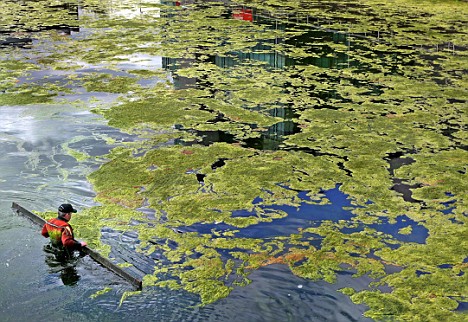
Earlier this week, I was attending my monthly fly-fishing club meeting. We had a couple of guests who were talking about their book on fishing in the Indian Peaks Wilderness Area (west of Boulder). Most of that area is only accessible by trails; no roads traverse it. That means that anyone who wants to get to some of the best fishable areas needs to pack in all of their supplies. The suggestion regarding water was NOT to take in a gallon of water. “That adds about 8.2 pounds to your gear,” remarked one of the presenters. “It’s better just to take a filtration device. But also, most of the streams are pretty clean; you probably could just drink from those. On the other hand, the same can’t be said for the lakes. For that water, you’ll need the filtration tools." I filed that suggestion in the “fishing/hiking” folder in my memory, to withdraw it this-coming summer when back-country expeditions will again be on my list of “to-do’s.” I was surprised, however, yesterday to find that it provided a pretty apt metaphor in an entirely different context. I was in a discussion with a number of other varied religious leaders and the conversation turned to a perceived stagnation among religious groups, a tendency (felt by all around the table) for religions to “harden”, to become dogmatic. And that when that happened, the group felt, many people drifted away or became positively disgusted by the tradition . . . AND it became increasingly difficult to attract new members. The image from the club meeting jumped out at me. It is almost inevitable that religious traditions move from being “living streams of water” into more settled, even stagnant, pools. The sociologists call it the “routinization of charisma”. That is, the leader who has the ability to galvanize his/her followers will, of course, die. Those followers will set patterns in place to continue his/her legacy, and those patterns will harden and be invested with the character of "truth". It doesn’t take long, and it may happen in direct disregard to the founder’s wishes. And, so, eventually, most religious traditions give rise to reformers who try to recapture the founder’s zeal and vision. As I thought more about this, I recalled the account of the Garden of Eden, out of which four major rivers flowed (Genesis 2.10-14). It was out of Paradise that nourishment flowed, not into it. It seems that we, in many traditions, make the mistake of telling others that they have to flow into our versions of paradise rather than our channeling the waters out. And, to pick up on the imagery from the opening paragraph above, there are rarely "filtration tools" available for most non-scholars to tease out the original freshness of the (probably) now-stagnant pond.
The challenge, of course, is that most of us cannot, or will not, become reformers, yet we yearn for others to know a less-stagnant version of our tradition. Maybe the most for which we can hope is to recognize the original beauty that flowed into our respective ponds and reflect that in our daily dealings and offer that to a thirsty world rather than becoming mired in the algae and weeds.
Even those of us who may not be pet owners generally will go "Aawww" when we're presented with a photo of a puppy, or a kitten, or BOTH. Put a picture of those cute animals behind bars (i.e., in a shelter), and the heart-strings are tugged even more. There's something about the eyes, I think. And the fluffy fur. Most of us turn into some kind of puddle of goo. Marketers CERTAINLY know this, and they play upon it -- just remember the animal-themed commercials from the Super Bowl. And it's not just puppies or kittens in television commercials. Those same marketers know that animals as part of a logo increase purchases. The larger story is that marketers (and others who want our attention) recognize that playing to our hearts is an effective way of claiming our allegiance. So, whether it's putting an animal on the tail of an airplane, OR a sad-eyed child in an appeal for donations, OR an incredibly polluted (or incredibly beautiful) river asking for letters to a legislator, the visual--as well as the thoughts evoked by that image--seems to have a direct effect on creating an emotional response. And the hope is that that emotional, internal, response will lead us to a REAL, external, response: buying, donating, lobbying, voting, etc. I certainly fall prey to this. Appeals to my "animal" nature work. But so do appeals to other loyalties: certain religious causes, various alma maters, favorite sports teams. My susceptibility, however, was challenged this week as I read, and then discussed, noted ethicist Peter Singer's The Most Good You Can Do: How Effective Altruism is Changing Ideas About Living Ethically (Yale, 2015).* Singer argues very persuasively that, if we want to do the "most good", we should follow our intellect, and not our hearts. We should do research on various "charities" before donating, to ensure that they are actually DOING good. We might even consider taking very lucrative jobs so we'd have MORE money to give away. We should count all lives as having equal value, regardless of whether they're next door or half-way around the world, and, therefore, send our money to help the MOST people. Much of what Singer says make a lot of sense! It makes a lot of sense, yes! And I've checked out some of the websites he suggests (GiveWell.org; 80000hours.org; animalcharityevaluators.org); they are ALL very interesting and compelling (and they do so WITHOUT pictures of puppies--although Animal Charity Evaluators uses farm animals). So, as far as I'm concerned, Singer's made his case. But I still can't quite go the whole way with him. In his commitment to valuing all lives equally, he finds little justification in support for the arts. Logically, I suppose, this makes sense (and he has a good argument about WHY he thinks this way). But, to me, the arts (broadly conceived) can inspire, can cause reflection, can soothe in such ways as to help me do more good.
So, I'm torn, but I'm not alone. Singer admits in his TED talk, that he falls short of his own ideals as well. But he challenges us -- he challenges ME -- to consider how I might do the most good. A similar call is found in the words attributed to Jesus in the Sermon on the Mount: "Where your treasure is, there will your heart be also" (Matthew 6.21). Is my heart--my whole being and commitment--REALLY in the places where I devote time and money. Or am I allowing myself to be swayed by puppy-love?Blessings,Gary* In case you don't have enough time to read Singer's book, or you're more visually oriented, here is a link to his TED talk on the subject.
In a murder mystery I began reading the other night, a Native American police tracker ends up in the hospital after an encounter with a bear. A couple of his friends went to visit:
The crowded room smelled herbally of smoke. Janice Inderland had burned a braid of sweetgrass and conducted a smudge ceremony to cleanse her brother's body of bad spirits.
The nurse . . . had to shush them twice. Under ordinary circumstances she would have booted them out, allowing no more than three or four visitors at a time. But the patient was Native American. Chanting, sweetgrass incense, and standing room only were cultural norms that the hospital staff recognized.*Cultural norms. Harold Little Feather's, like the rest of his peoples', were different from those of most westerners. The hospital ran, of course, on primarily western norms. Its staff, however, had learned that there were some things that couldn't necessarily be "normed" away. This can be a major challenge for us all, as many of our norms/assumptions are so ingrained in us that we can't imagine that they aren't universal.
I have been reminded of this every January for the last several years when I'm invited to give an introductory lecture in a bioethics class. I use, as a basis for the lecture, a theory called "Principlism", developed and applied to bioethics, by Tom Beauchamp and James Childress some years ago.** It is a wonderful set of tools/criteria for helping make difficult decisions. But one of the "principles" is "Autonomy". Beauchamp and Childress try to claim that Autonomy is not the first/most important principle, but it does seem to undergird the others. Briefly, the assumption is that an individual has the (almost supreme) right to make decisions for him/herself. "Informed consent" may be another way of talking about the same thing. But that assumption is a western, post-enlightenment, assumption. It discounts a possible "divine claim" over the individual (which we see sometimes in religious reasons/prohibitions surrounding certain medical procedures). But it also discounts other cultures' elevation of the rights of the "tribe" or "family" over those of the individual. Whose "norms" are right?
Prior to my last opportunity to lecture to this class, I heard and read news item about the collision of cultural norms in India. The Jain religion--a very ancient tradition devoted to non-violence--holds as a high virtue a sort of suicide. When a person reaches the end of their "useful" life, it is honorable for them to cease taking nourishment and, thus, to die. The problem is that the colonial British imposed western ideas/prohibitions about suicide that became enshrined in Indian law. A very real collision of norms . . . and one could easily argue that the "new" (i.e., Western/British/Christian) supplanted the "ancient" (Indian/Hindu/Jain). But was the new . . . "better"? Or was it an exercise in hegemony of a norm -- "might makes right"?
These sorts of collisions occur all the time. And our usual response is to judge others' norms in the light of our own -- and usually to privilege our own. But as the world becomes "smaller", we will become "bigger" when we all recognize our system(s) may not hold all the answers. As a foundational document in the western tradition suggests "Pride goeth before destruction, and an haughty spirit before a fall" (Proverbs 16.18). Sage advice.
Blessings,Gary* Keith McCafferty, The Gray Ghost Murders. Viking, 2013, p.16.
** Tom L. Beauchamp and James F. Childress. Principles of Biomedical Ethics, 6th Edition. Oxford: Oxford University Press, 2008.
I am away this weekend tending to some sad family duties. What I've cut-and-pasted below provided me with some needed smiles. May they brighten your day as well.
After every flight, UPS pilots fill out a form, called a "gripe sheet" which tells mechanics about problems with the aircraft. The mechanics correct the problems, document their repairs on the form, then pilots review the gripe sheets before the next flight.
Never let it be said that ground crews lack a sense of humor. Here are actual maintenance complaints submitted by UPS pilots ("P") and solutions recorded ("S") by maintenance engineers:
P: Left inside main tire almost needs replacement.
S: Almost replaced left inside main tire.
P: Test flight OK, except auto-land very rough.
S: Auto-land not installed on this aircraft.
P: Something loose in cockpit
S: Something tightened in cockpit
P: Dead bugs on windshield.
S: Live bugs on back-order.
P: Autopilot in altitude-hold mode produces a 200 feet per minute descent
S: Cannot reproduce problem on ground.
P: Evidence of leak on right main landing gear.
S: Evidence removed.
P: DME volume unbelievably loud.
S: DME volume set to more believable level.
P: Friction locks cause throttle levers to stick.
S: That's what friction locks are for.
P: IFF inoperative in OFF mode.
S: IFF always inoperative in OFF mode.
P: Suspected crack in windshield.
S: Suspect you're right.
P: Number 3 engine missing.
S: Engine found on right wing after brief search.
P: Aircraft handles funny.
S: Aircraft warned to: straighten up, fly right, and be serious.
P: Target radar hums.
S: Reprogrammed target radar with lyrics.
P: Mouse in cockpit.
S: Cat installed.
I'll be back next week! 'Til then,
Blessings,Gary

As a religion/anthropology/sociology-geek, one of the things that really gets my goat (not meant to be a sacrificial reference!) is the fast-and-loose way people use the word "myth". According to thefreedictionary.com, the first definition of "myth" is: "A traditional, typically ancient story dealing with supernatural beings, ancestors, or heroes that serves as a fundamental type in the worldview of a people, as by explaining aspects of the natural world or delineating the psychology, customs, or ideals of society". That pretty much is in accord with what I was taught many years ago in my religion classes. There is nothing in that definition that addresses the question of "true" or "factual", although as soon as "supernatural" is mentioned, many "moderns" immediately jump to the conclusion that there is no factual nature. In the same dictionary entry, it isn't until the third and fourth definitions that "fiction" or "half-truth" are mentioned. Other dictionaries, on the other hand, put those "fictitious" definitions at, or near, the top--again, I suppose, reflecting a "modern" world-view.* So, in common parlance, "myth" generally means "false"; myths are to be dispelled and mythic stories become less-than-valuable.
On the flip-side, however, are those many people who will talk about the modern "myths" that we've created in the last several decades, the "Star Wars" trilogy being, probably, the best example. In other words, there are folks who recognize the power of story, even a story that isn't, even potentially, "factually true" (most of us hope there is never a Jar Jar Binks on the planet Naboo!). This discussion, of course, has taken on new currency with the recent release of the first episode of the third "Star Wars" trilogy. Commentators of many stripes are noticing how the "Star Wars" story has taken the place of many earlier mythic epics, and we hear conversations about "Gilgamesh" or Homer's Iliad or Odyssey, or even biblical stories! It is clear, whether we're talking about ancient stories--based on historical events or not, or novels on the New York Times "Best Sellers List", stories are our attempts to make sense of our lives, to understand our place in a greater world, and, in some cases, to inspire, or encourage, us to take some kind of action. And the lasting power of some stories is a testament to their power to do just that. So, I have to ask, what kinds of stories, great or small, are we telling these days? Are they life-giving or soul-sucking? Or, in what direction do they lead us? Or, if they move us to action, is that action to the good or not?
I know which kinds of stories I prefer to read or watch or hear. Yes, I most often appreciate good character development and a happy ending. But chiefly I want stories, whether mythic or not, that will challenge me to rise above my current situation, or that can give me hope in tough situations. Probably that's what many of us want. The danger is that some of the "stories" that we hear promise us "hope" at the expense of others. Evil must be defeated, yes. But "manufactured evil", falsely creating an "enemy", so that "we" can win is a loss for all. In the end no-one rises; little is improved. Those stories fit definition number 3 of "myth" in The Free Dictionary: "A fiction or half-truth, especially one that forms part of an ideology."
So, what ARE the stories we are telling? Or, more importantly, what stories are we hearing and accepting? To which definition of "myth" do they belong? What kind of people/society are they forming? Blessings,Gary
Last week, I made reference to an idea I had gleaned from religious/spiritual author Alan Watts. Coincidentally, at an event last evening, I recalled another work of his, actually his last: Tao: The Watercourse Way. The reminder came as I was listening to someone describe the spiritual life (or a religious vocation) as getting into a river and, rather than fighting it, allowing the current to carry you to the river's ultimate destination. And I remembered that one of the characterizations of a Taoist way of being was simply (in current parlance) to "go with the flow." As one blogger put it: "Water is the supreme example of acceptance. It never struggles, it simply flows. It does not resist its path. It does not resist The Tao or the way. It just is. And even though water is the most humble of things—offering no resistance—it is also the strongest of things. By simply flowing, it is capable of wearing away even the most solid rock" (emphasis in the original).
In contrast to that experience/recollection, I immediately remembered another blog entry I had read earlier this week, entitled "Stay Happy and Healthy: Go Fishing".* The post touts many of the benefits of fishing (primarily fly-fishing). Mental health: "Fishing is by nature a reflective and meditative activity that forces you to slow down and enjoy your surroundings." Physical well-being: "The best [anglers] learn to develop casting accuracy through practice. This helps build hand-eye coordination and strengthens the small muscles in your hands, wrists, forearms, biceps, triceps, and shoulders." Rehabilitation: "Even the U.S. Veterans Health Administration has adopted the use of fly fishing and fly tying as a recreational therapy for injured military veterans because these calming, repetitive, low-impact activities help them regain strength and the use of their muscles." But what I recalled last evening was the bit in the blog about wading against the current, and the benefits: "Navigating rough terrain and slippery rocks while resisting the current in a river challenges your balance, building strength in the little-used muscles and tendons in your feet, ankles, calves, and shins. Hiking up steep slopes or riverbanks builds strength in the large muscles of your legs, such as the quadriceps and hamstrings." I certainly can attest to the fact that, after a day in the river, I'm pretty worn out, and those "little-used muscles and tendons" are demanding a rest. Add to that the claim (in the image above) that 4 hours fishing burns 1000 calories . . . . I love this sport!
And, so, in reference to making any kind of progress in the spiritual life, I began to wonder whether it was always such a good idea to pick up my feet and let the current carry me where it would. There is benefit, on the contrary, in working "against the current". Just as in wade-fishing, we strengthen practices that can sustain us in difficult times. We may also find that some of the extra "baggage" we are carrying gets burned away. We may also recognize that we've stumbled into a side channel that diverts us from our true goal. Carrying the metaphor maybe a bit too far, and changing it slightly, the trout in a stream generally swim against the current, maintaining their position, knowing that the current is what brings them food.
So, perhaps, it is a good thing to let the current carry us --- some of the time. But turning around and doing the work of wading (or swimming) upstream can strengthen and feed us in ways that resting in the current cannot.
Blessings,