Friday, December 9, 2011

Occupy . . . my heart!

   
       Amazing what a walk will do!  I was heading this afternoon from my office to the gym, mentally putting the finishing touches on what I might write this afternoon.  I had had a student earlier in the week come talk to me about Occupy Denver.  And then, this morning, I was listening to an interview having to do with religion, zombies-on-TV, and popular culture.  What RICH material for an afternoon's meditation!  But, as I walked the snowy path to the fitness center, I noticed heart after heart after heart scribed in the snow.  Sometimes there was an arrow through the heart, but most often a single heart.  There must have been 25 or 30 of them on either side of the path, or, as in the photo above, on the snow remaining on top of one of the hedges.
      Occupying zombies went out of my head, and I realized that something as fleeting as a snowy heart was much more noteworthy.  (I may return to zombies and the Occupy movement in future weeks.)  But, on a day when I was tired, but knowing I needed time on my spin bike (which would both invigorate and exhaust me further), the procession of hearts took ahold of mine.
      Someone, possessed by some spirit, took the time to stop every so often and, with two or three swipes of a finger, left for those coming after him/her a somewhat whimsical bit of encouragement and hope.  After I saw the first couple, I kept looking for more and they kept appearing. They even crossed busy thoroughfares.  My spirits rose; my fatigue left.
      In a time of the year when the light begins to wane, when days grow shorter, we long for light.  All of the religious/spiritual traditions that light candles or bonfires at the winter solstice witness to this longing for new life.  We look for the rekindling of light, for refreshment of heart.
      The anonymous heart-carver provided that for me.  And the juxtaposition of the heart with the leaves poking through the snow simply doubled the message.  None of us are prevented from providing similar simple messages of hope; a couple swipes of a finger in the snow and our hearts are occupied in an entirely different way.

Blessings,

Gary

Friday, December 2, 2011

The end is near! So what?

      One thing that has confused me for some time is the fascination some folks have with knowing the future.  This came to mind again last Sunday.  In much of the western Christian world, last Sunday was the first Sunday of Advent, a four-week period of preparation leading up to Christmas.  One of the selections from the New Testament that (in my tradition) was appointed to be read had Jesus predicting the destruction of the Jerusalem Temple (Luke 21:5-19).  His followers asked him when this would take place, what would be the signs that it would be about to happen.  Jesus refused to give a direct answer; indeed, in another place, he asserted that  "about that day and hour no one knows, neither the angels of heaven, nor the Son, but only the Father" (Mark 13:32). His message seems to have been: "Quit worrying about it!"
        What IS it about knowing the future?  If it is "fixed", then knowing about it wouldn't change anything anyway!  Any changes we might make in our life or habits would simply be a factor in what would happen anyway; it wouldn't change!  If the future is fixed, we can't run from it; it will be what it will be.  If the future isn't fixed, then how can one know it?  [The "Ghost of Christmas Yet To Come" in Dickens' A Christmas Carol is a different critter -- a ghost of a possible Christmas to come -- as Scrooge CAN, and does, make a change that affects that future.]   Indeed, knowing the future may even have bizarre effects on our behavior: "Well, the world's going to end, regardless of what I do, in 2012, just like the Mayans said! So I can behave any old way I want! What's the point in saving money, or saving the whales?"
        So I've never been one who has been that interested in the future.  When will the world end?  I don't know, and I probably can't do a lot to accelerate or delay it anyway.  I think it's much more important, and within my grasp, to attempt to forge, to create, a future that is worth inhabiting.  Gandhi, in his development of his theory of satyagraha, or "truth-force", in the context of an argument over whether or not the end justifies the means, wrote of the inseparability of means and ends: "They say, 'means are, after all means'. I would say, 'means are, after all, everything'. As the means so the end . . .  There is no wall of separation between the means and the end.  Indeed, the Creator has given us control (and that, too, very limited) over means, none over the end."*
        I would hope that the "end", the future I would hope to see, is the product of the means I employ to reach it. Right means -- that's enough to worry about!   Is the end near?  "So what . . . now?" seems the primary and appropriate question.

Blessings,

Gary

*R. K. Prabhu & U. R. Rao, editors; from section “The Gospel Of Sarvodaya, of the book The Mind of Mahatma Gandhi, Ahemadabad, India, Revised Edition, 1967.

Friday, November 18, 2011

Thanks-gifting

       Every month I spend a Friday morning at Metro CareRing, a large food pantry (and more) in downtown Denver.  I began going last March, along with a BUNCH of DU students.  I decided that day that I would continue going monthly, whether I was joined by any students or not.  It has turned out to be one of the things I most anticipate every month.  Even more so in the last couple of months.
      When I first started going, my main role was to fill orders from the clients in the pantry.  I would be given a shopping list and I would fill it -- given the available items and my creativity ("Hmm, would they rather have spaghetti noodles or macaroni as 'pasta'?").  In mid-October, however, Metro CareRing went to a "client choice" set-up.  Now my role is as a "personal shopper;" I accompany the clients through the pantry, helping them negotiate the aisles, letting them know how many of certain items they may take, picking up heavy items, and so on.  The difference between this latter system and the former is amazing.  I actually get to interact with the clients, and they with me.
       Today was my monthly opportunity to be a "personal shopper."  As I anticipated, many of the clients were looking forward to Thanksgiving.  And they were all overjoyed to receive a turkey in addition to everything else.  I don't think I've ever heard the words "Thanks" or "Thank you so much" that many times in a few hours.  And I heard it not only from the clients, but from the staff -- both TO the clients, and to each other and the volunteers.
There was no sense of entitlement anywhere apparent.  All that was clear was gratitude.  Smiles and laughter were abundant.  The sense that "all is a gift" overwhelmed me.
      I began wondering, even before my time at Metro CareRing today, whether the "Thanks" on Thanksgiving are due only to God (and the cooks), or whether we might take the day a bit further.  Last week my office gave folks crossing the "Bridge" at DU the opportunity to write a Thank-You to ANYONE, and we'd deliver it.  Cards went to faculty and family, staff-members and sorority-sisters.  The avenues of grace are all around!
      So, next Thursday, somewhere between the hors d'oeuvres, the football games, the pumpkin pie (and inevitable subsequent naps), in addition to the thanks we render to the Giver of all gifts, maybe we can make some time to say "thanks" to the people who surround us, near and far, and who give us the everyday gifts that bring smiles and laughter to our lives.  That word can be a gift that never spoils or wears out.

Happy Thanksgiving,

Gary

Friday, November 11, 2011

You can't trust the box!

       When I was growing up, there was a saying in our house that "You can't trust the box".   Whether it was at birthdays or the holidays, the caution came out.  A box that might have held copier paper might hold a pair of cufflinks.  Or a shoebox might hold instructions telling the recipient to look in the garage at a new drill press.  That pattern has stayed with me, and my children are learning not to trust the box!
       I remembered this last Sunday when I hear the Most Rev. Katherine Jefferts-Shori (the head of the Episcopal Church in the United States) answer questions after presiding at the morning worship at St. John's Cathedral.  In her answer to one question, she made a comment something to the effect of "don't confuse the gift with the package."  The context (if I recall) had to do with traditional religious expressions in a contemporary context.  The general point was that God has given the world multiple gifts.  We end up putting them in boxes.  And, voila, the gift and the box become, for all intents and purposes, one and the same.
      A similar phenomenon was characterized by Max Weber in his classic studies  of the sociology of religion as the "routinization of charisma".   A leader/reformer arises whose (usually anti-traditional) message, as well as his/her passionate, effective presentation of that message, attracts a LOT of attention and followers.   When the leader dies (or even during his/her lifetime), the initial momentum invariably wanes, and a structure is created to keep the movement viable.  Over the course of time, the initial message becomes a bit lost in the doctrines and practices that arise with the structure.  In short, the "charisma" becomes "routinized"; the extraordinary becomes ordinary, routine, perhaps mundane.  It indeed may happen that the evolved structure becomes almost antithetical to the original, captivating, vision of the founder.
     Weber argues that this process is practically inevitable.  Just as is our tendency to confuse the contents of the box with the box itself.  Reformers of all stripes realize this, agitate for change . . . and the process begins again!
      I took Bishop Katherine's challenge to us to be:  "Look closely at your sets of fondly-held beliefs."  Do we hold more tightly to the gift or the box?  Can we distinguish between the two?  Even if we hold tightly to the container, is it the ONLY container that can hold the contents?  Or might new containers -- larger, or smaller, or differently shaped -- cradle the gift equally well?
      And I thought, "You can't trust the box!"

Blessings,

Friday, November 4, 2011

Generously overturning the pot

Just as a filled pot, which is overturned, pours out all of its water, leaving nothing back, even and exactly so should one give to those in need.  Whether low, middle or high, like the overturned pot, holding nothing back . . . .!  (Jataka Nidana 128-29)*

       A student recently recounted to me an interaction she'd had with a fellow student in her Latin class.  She noticed that he was wearing a t-shirt emblazoned with the name of the heavy-metal band "Bullets For My Valentine".  She remarked to the young man that she liked the group's music.  His response:  "Wow, you don't fit the stereotype" (i.e., of the people who like their music).  The implication, of course, that one has to "look a certain way" to appreciate various kinds of music.  (Let's not even get into the issue of heavy-metal devotees taking Latin!)
      It was a coincidence, to be sure, that, yesterday, as I was driving to a conference I'm attending, that the drive-time morning show folks were talking about stereotypes that were "problematic".  They had callers phone in who didn't fit (let alone appreciate) certain stereotypes associated with their professions.  Those who called in included:  a petite, well-dressed, female long-haul truck driver; a CPA with a sense of humor; a nurse who didn't wear high heels or show her cleavage.  Whether or not any of us accept these as stereotypes, the callers certainly had experienced them that way - - and didn't like them!
     And it was certainly another coincidence that, at my conference, I found myself paired with a woman who works for large agency within the federal government who, herself, didn't think she could ever be a "government worker" because they were all like . . . . "that" (fill in the "that" with YOUR stereotype of government workers).  She found, to her amazement, that she was an in "an amazing work environment" with people who were incredibly dedicated to making a difference.  In the course of her and my conversations, MY stereotypes of "government workers" (probably mirroring her initial suspicions) were destroyed.
      The key to the change, of course, was personal experience and conversation.  In our case, over the last few days, those of us at the conference have been given the opportunity to be pretty open with each other (and the rest of the conference attendees).  We've had the chance to talk about our strengths and fears, successes and failures.  In short, to "overturn our own pots", leaving nothing back.  The outcome and effect, of course, was deeper understanding and acceptance.  Those things that might have artificially divided us -- and stereotypes, in my mind, are artificial constructs that divide us -- were obliterated.
      We all want to be understood.   Our world demands that we strive to understand one another (almost all media messages to the contrary).  Yet we acquiesce to stereotypes; we perpetuate them.  So it's an incredibly generous gift to another person to engage them, to walk together past the stereotypes, to find understanding.
      Overturning our pot is the necessity of our time.  In doing so, we might find that we can complement each other to make our world better.
       Hold nothing back!

Blessings,

Gary

*The "Jataka tales" are accounts and stories of the prior incarnations of Siddartha Gautama, the Buddha.  They are part of the sacred Buddhist scriptures.

Friday, October 28, 2011

Bounce me higher!

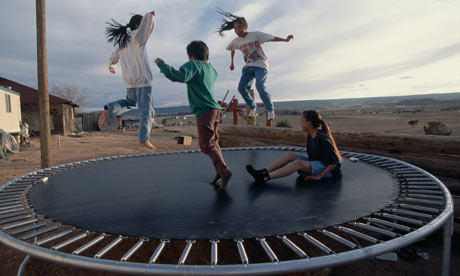
     In the twelfth chapter of Jonathan Mooney's captivating book, The Short Bus: A Journey Beyond Normal*, the author introduces us to Katie.  Katie is twenty-four year old woman (at the time the book was written) with Down syndrome.  Mooney (who, as a child, was labeled "dyslexic and profoundly learning disabled") had been traveling the country in a short bus -- the kind of bus special education children often ride to school.  He has been meeting adults for whom that bus was a reality; one of his last stops was with Katie.  At the end of his time with her, Mooney's traveling partner at the time suggested that she, Katie and Mooney get on the big trampoline in Katie's back yard.  Mooney was clearly not interested, but joined the two women:

"It is better if you jump together," Katie said.  So Kelly and I jumped together, our bodies slowly adjusting to each other's weight. Then Katie joined us.  We had only a few more minutes left, so Kelly, Katie, and I threw our bodies in the air and we fell into an unspoken rhythm, each of us using our weight to throw the other one up a little higher than we could ever go simply on our own.**

I was struck by the image and had to put the book down for a few minutes to let it soak in. What an amazing metaphor for cooperation and encouragement.
     I think what struck me so much is how little we hear about encouragement (maybe that's just my perception).  Certainly I hear it among members of athletic teams; they recognize that their own individual and team success depends on the success of all on the team.  But when I considered this in a broader context, I couldn't come up with a lot of other examples.  Indeed, the counter-examples are pretty apparent, from political debates to international relations to some inter-family relations.  The scarcity model reigns:  "If YOU succeed, then, in all likelihood, you'll have gotten the laurels, and there are none for me.  So why encourage YOU?"
      What Katie realized, and what Mooney and Kelly learned, was that despite their differences in abilities, weight, trampoline experience, whatever, if they used what they individually brought TO that trampoline to serve the others, they could all achieve more.  The language Mooney used suggests that there was no agenda on any of their parts, only to jump together on the trampoline.  And then they "fell into an unspoken rhythm" that produced the elevated results.
     Golly, I know I like to hear "encouraging" words, but it seems that on this "range" these days, seldom are heard encouraging words.  Yet if that is what we want to hear, if that is what we want to experience, then perhaps taking the initiative TO encourage might start a trend.  It would be consistent, certainly, with the so-called "Golden Rule" that runs through every religious tradition.  And maybe we could all,together, end up a little higher than we might on our own.
       So, how can I encourage you?

Blessings,

Gary

* New York:  Holt Paperbacks, 2007.
** p. 200.

Friday, October 21, 2011

Is the best use of time . . . not to?

       The other day I found myself in a room listening to some pretty nice music.  I had nothing I needed to do EXCEPT listen; there was no other place I needed to be.  And I found it almost impossible to keep my hands off of my smartphone.  I felt absolutely drawn to check my email, or update my to-do list -- right in the middle of doing what I was scheduled to do!  I rationalized that I was making good use of my time.
       And, immediately, as I realized what I was doing, I recalled an article I had read just a day or so earlier.  The article came to my via the social network site "LinkedIn" -- a medium for professionals to make connections -- a very work-oriented social network.  And the article itself came from the magazine "Fast Company", described on their website:

Fast Company is the world's leading progressive business media brand, with a unique editorial focus on innovation in technology, ethonomics (ethical economics), leadership, and design. Written for, by, and about the most progressive business leaders, Fast Company and FastCompany.com inspire readers and users to think beyond traditional boundaries, lead conversations and create the future of business. 

The article's title?  "What Happened to Downtime?  The Extinction of Deep Thinking and Sacred Space".
       In it, the author (listed as "The 99 Percent") begins by stating that "interruption-free space is sacred.  Yet in the digital era we live in, we are losing hold of the few sacred spaces that remain untouched by email, the Internet, people, and other forms of distraction."  The author goes on to argue that this loss of "sacred space" is partly due to our fear of what that space affords:  "To escape this chasm of self-doubt and unanswered questions, you tune into all of the activity and data for reassurance."  So, in the midst of beautiful music (following on the train of thought in the article), I feared being unproductive and turned to that security blanket:  my Android smartphone!
      The article also suggests, however, that in moments of un-connectedness (such as in the shower), we often have those "ah-ha" moments.  We are not "fully engaged in a creative activity" and another form of creativity is able to break through.  A walk through the fall leaves?   Sitting quietly in a church/temple/mosque?  Listening to beautiful music (without an accompanying video)?  Space for inspiration?
       I remember that I hesitated getting my first cell phone because I didn't want to be constantly available.  Things changed, and it became a necessary accompaniment to my life (mostly work-related).  And then the worm turned, and that phone began to control me, to demand that I attend to it--even when no one was calling or texting me.   And empty time became busy time.
       A break from busy time?  Have we turned time into such a precious commodity that it has to be used judiciously, efficiently, intentionally, constantly?  Might occasionally "wasting" time be its best use?  Ironically it was "Fast Company" that encouraged me to consider slowing down.
       Tempus fugit.  So what!?
   
Blessings,

Gary