|

Friday, November 30, 2012
Brilliant!


Friday, November 16, 2012
A fair perspective.

Jonathan Haidt, a moral psychologist, and author of the recent book The Righteous Mind: Why Good People Are Divided by Politics and Religion, states that, if you want to know why different people hold different positions on issues, you should "follow the sacred". That is, what different people hold as sacred (it could be a place, a text, an ideal, or so forth) is what will drive their arguments. And, as the title of his book suggests, these arguments can be over both politics and religion. He (and his colleague) identify six ideas fundamental to moral systems: care, fairness, liberty, loyalty, authority and sanctity.
I was struck by one of those, and his discussion surrounding it: fairness. Haidt (in an interview) observed that all of us believe in fairness, it's just that Republicans and Democrats, by and large, view fairness through a different sacred lens. For Republicans, fairness equates to proportionality; for Democrats, it equates to equality. So, why someone from either group mights claim "It's not FAIR", a member of the other group might, in their minds, rightly claim, "Yes it is!" I've been playing with that distinction in my mind for several days now, having found myself in various contexts (and recalling the arguments about various election issues) that have related to fairness.
Fairness, of course, is pretty religious issue. Many of the stories of the patriarchs of the Hebrew scriptures have questions of fairness at their base (Cain and Abel, Jacob and Esau, Joseph and his brothers, etc.). And certainly a number of Jesus' more well-known parables challenged his listeners' (and our) concept of fairness. A chief example is know as "The Laborers in the Vineyard" (Matthew 20.1-16) in which a vineyard owner hires a number of day-laborers over the course of a day . . . and pays them all the same. Those who had worked all day didn't think it fair that those who worked an hour received the same wage. Most of us would agree.
Another of Jesus' well-known parables, that of the Prodigal Son (Luke 15.11-32) also plays with the theology of fairness. The young son takes his half of the inheritance and squanders it, returning home, only with the hope that he'll at least get a meal. The older son, seeing the party their father threw for the young degenerate is furious! "It isn't fair!" he cries. "I've slaved for you, dad, and you've not thrown me a party. But for the brat? You've killed the fatted calf!!" Again, many of us would side with the thinking of the older son: "Work hard, and you'll be rewarded; party hearty and you'll pay the price. It's only fair."
What strikes me about both of these parables, and, indeed, a lot of our thinking about fairness, is that we have a particular perspective from which we evaluate the story. Probably none of the laborers in the vineyard felt the way the payment was awarded to be "fair". The long-working folks felt they were getting ripped off; the others felt lucky. The same could probably be said of the two sons. Both sets of characters believed and operated within a system that didn't seem to play right for any of them.
But there are yet other perspectives to consider: that of the vineyard owner or that of the father. For them, it didn't seem like "fairness" was the issue at all. Both of the parables are about generosity and/or mercy. And I've often thought that we really don't want a God who is fair. Because how many of us really want what we deserve? We more often want a God who is on our side of the fairness issue -- giving to the others their just desserts. And we're happy that we seem to be on the mercy-receiving end most of the time.
Much of the biblical witness, however, de-emphasizes fairness in favor of mercy. In Islam, a primary quality of Allah is mercy. One of the most popular figures in Buddhism in Guanyin, the goddess of mercy. We all want and need mercy.
So I wonder, what might it mean, in our religious and political debates, if we asked, not about whether or not something was "fair", but whether it was "merciful"?
I suppose it still would be something akin to looking at an Escher drawing. Are figures walking up? Down? Across? Each of them would probably have a different perspective on the other; they might consider their place in the drawing as "sacred". But from above? Different entirely.
Blessings,
Chaplain Gary
Friday, November 9, 2012
Unplug for more energy!

Several weeks ago, I wrote about a wonderful concert my wife and I attended at the Hollywood Bowl. In an LA Times interview prior to the show, the artist, Latin pop sensation Juanes, spoke about his mid-life career burnout. The Times reported:
He was burned out with touring and recording, and his young children were always crying, "When is papi coming home?"
"I was bored, I wasn't feeling good about things," acknowledges the artist. . . . "It was a crisis. I felt lost. So in this moment of transition I thought, 'What do I do now?'"
The answer was provided by the Spanish-language MTV channel, Tr3s: "Do an unplugged show." The result was a CD, a DVD, a #1 album and multiple Latin Grammy nominations. Working without all the synthesizers and electronic backup, Juanes found himself re-energized. His fans were enthralled.
Many of us have seen "unplugged" concerts (if only on television) The venue is more intimate. The audience is seated closer to the performers. Pyrotechnics are generally absent. And familiar songs, made almost uninteresting by constant repetition on the airwaves, take on a very different feel. Unfettered somewhat by the expectations of the audience (i.e., that the music sounds just like that on the album), the artist can put a bit more of him or herself into the music -- especially true if they are a singer-songwriter.
This image of "unplugged concerts" was suggested to me by something I heard earlier this week. There was a slight difference; the reference was not so much to music, but to stories. Stories that we read or hear over and over. They may represent different versions on the same basic narrative (the four Christian gospels are an example). Or they may be the same narrator telling the same story in different contexts. But many of us find ourselves, when confronted by a different version, saying, "Wait a minute! I've heard this before, and the version you're telling now isn't right, or it isn't what you've told us before!"
Well, of course, story-tellers (singer-songwriters) have every right to make the story their own at any time they tell it. The problem is ours, as we come to expect a certain outcome based on prior experiences. And our attachment to that expected outcome may limit our ability to hear the story/song in its different form, missing the nuances or multiple layers. This is point number one: we need to be attentive to the nuances between stories, for contained within them is a deeper story -- the individual's own story, not just that which is told in the words of the song/tale.
Point number two is a little different. We often get trapped in the surface-level stories we create about ourselves that we lose sight of our own deeper realities, our hopes, fears, insecurities, strengths, etc. And our being constantly "plugged in" to music, the cyber-world, work, sports, food, election coverage, or whatever, helps shield us from that deeper self. So, maybe, for some of us the weeks between Thanksgiving and the resumption of school in January may provide time for us to unplug from the usual distractions and return to our core stories. Maybe we can return mirroring the description of Juanes:
"He has realized a new ambition for what his music can be, of the many things that his music can take in,". . . "He's growing as a musician, he's playing better than ever. It's a new stage for him. I believe the best is yet to come for Juanes."
Blessings,
Chaplain Gary
Friday, November 2, 2012
Your compass points where?
I've just come from a very provocative lecture/discussion on Religion and Violence. The main speaker, Prof. Hector Avalos of Iowa State University, argued that religion almost necessarily produces violence.* He believes that religion creates one of several "scarce resources" (e.g., access to sacred space or salvation), and that, then, believers control access to those resources. This controlled access to a desirable resource results in conflict and, ultimately, in violence. He had numerous examples from texts from Judaism, Christianity and Islam, as well as contemporary issues, that he felt supported his claims. It was a compelling argument, although the two respondents (one from Iliff School of Theology and the other from Denver Seminary) took issue with several of his claims. I, too, found much with which to agree, as well as much with which to argue.
What he had to say, however, shed a bit of light on some things that I've been mulling this week. Many of us have Facebook "friends" who post things to their page that (possibly) give intriguing insights into their personality/beliefs. And, so I've been struck, as this election cycle reaches it zenith (or nadir) by the kinds of political stuff that is passed on via the "Share" button. Two of my "friends" have shared posts originally appearing on the Facebook pages "Christians Against Barack Obama" and "Americans Against the Tea Party" (my friends do not compose a monolithic bloc!).
All I want to infer about my friends is that they found something in the original posts that resonated. On the other hand, what struck me were the respective names of the Facebook pages they shared: "So-and-so AGAINST such-and-such." The page-names set up opposition; they set up conflict. Ultimately, I suppose, they could set up violence. The first case ("Christians against . . .), suggests at least a couple of scarce resources: (1) who/what is a "Christian"; and (2) that there is an assumed "real" Christian candidate (which, of course, does not include the current incumbent). In the second case, a similar assumption is made over the ownership of the title "American" and its agenda. In both cases, you're either in or out, and "spoilin' for a brawl".
But what also bothers me is that both of these groups argue about what they are "against". And lots of Facebook posts do so as well, without the reference to such antagonist Facebook pages. And the same is true in most of our political ads this cycle; the last statistic I heard was that over 70% of political advertisements were negative. "Don't vote for THAT Bozo! We'll go to hell in a hand-basket if you do!" How rare it is to see/hear an ad that says "Vote for this candidate, because she will do . . ."
Also, this week, I was listening to a couple of conversations hosted by Krista Tippet of the radio program "OnBeing." These were part of a series called "The Civil Conversations Project". One of the conversations was on the institution of marriage, the other on political bridge-builders. In both cases the conversation partners were those who "sat across the aisle" from the other on the issue at hand. Yet, in both, they were able to identify core issues over which they agreed. It was the centrality of the issue that united them in solving the problem, NOT the centrality of their position on the issue, nor their certainty that they were right and the other wrong.
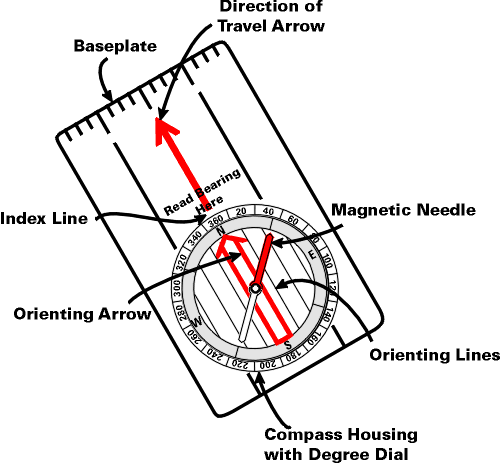
In one of the discussions, one of the folks spoke about the need for following a moral compass. And I began to relate that back to the Facebook issue. The pages to which I refer are NOT talking about following a compass toward a destination, but rather about turning away from a different direction. Turning away from "west" does NOT mean one will turn "east"; heading "south" or "north" may not solve the problem. My assumption (naive it may be) is that these Facebook folks ultimately want much of the same thing (less debt, adequate security, etc). But the rhetoric they employ sets up "scarce resources" leading ton conflict and violence.
So I have to wonder about which direction our compasses are pointing? Are they simply pointing away from a problem, or toward a solution? Prof. Avalos ended his talk this afternoon with some of the things that might resolve the "religion creates scarce resources creates violence"trajectory. One of those was to expand the resource base; end the scarcity. The language we use is one way of doing that. Checking to see if our compass works is another.
Blessings,
Chaplain Gary
* To be fair, Avalos doesn't say that only religion produces violence, or that all religions always produce violence.
PS: Vote this coming Tuesday (if you haven't already). But vote for something/someone, not against the alternative!
|
Friday, October 26, 2012
What's beyond you?
|

Friday, October 19, 2012
Bring it!

Fatigue-produced responses indeed. For I certainly know what he means; it's just fun to toy with him. He wants us to bring maximum effort to our workout. Despite those who say "No Pain, No Gain" or "Feel the burn!" no longer hold sway, there are many of us who feel that if we haven't pooped ourselves out, the workout was somewhat in vain.
We hear it often enough: "We want your best effort!" "Leave nothing in the tank!" Or Yoda's words to Luke Skywalker, "There is no try, only do." The implication is, it often seems to me, that anything less than total commitment/expenditure is hardly worth anything. The shadow-side of that, however, is that we may often feel that we have nothing to contribute, let alone give our all. And so we can sit back and wonder, "Why even try?"
I'm reminded of an old story I heard somewhere in my youth. An elderly man, who had been so active early in life, had succumbed to severe physical limitations due to age. A sense of uselessness descended upon him. "What good am I now?" he asked his pastor. The wise counselor responded, "You can pray for all of these people on this list." Now there are a lot of recent studies on the power of prayer, and I'm not going to go there! But the pastor pointed out something quite profound: even when we think we are unable to bring anything to a situation, we've still, most likely, got something left.
We live in such a competitive environment. Whether it's athletics, business or education, we feel that we are only worth all of the big "stuff" we bring to a situation (strength! speed! number-crunching acumen! clever advertising slogans! multiple advanced degrees, patents or publications!). But often, what is needed is something much different. Perhaps it's a simple phone call. A kind, or consoling, word in the hall. Maybe a touch on the arm. Maybe it's simply something we all can do: share an understanding silence.
Of course, we do have special skills, talents, and gifts that we can also employ. But the "IT" we all can tap is the deep well of our common humanity. And given the troubles we face in our world, from fractious political contests to those experiencing financial ruin to those who've just done poorly on an exam, a gentle expression of humanity is probably what is the most needed.
So, Bring IT!
Blessings,
Chaplain Gary
PS: "Back it down to 5." "Boo-yah!" (Those who have ears, let them hear!)
Saturday, October 13, 2012
There be dragons!

A number of years ago, when I was Episcopal Campus Minister at UC-Berkeley, as part of my job, I "managed" a student residence (in a building over a hundred years old!). Three floors, eighteen students. Men and women. Different races/ethnicities. Different religious backgrounds. Both graduate and undergraduate (although mostly the latter). Part of the "management" meant addressing clogged drains, the internet not working, dealing with various "pests", taking the change out of the laundry machines, painting vacant rooms, etc. All of that meant that I was often walking through the building on a relatively regular basis.
Walking through a residence hall, one often hears snippets of conversations; my experience at Berkeley was no different. Most often I'd hear one half of a phone conversation, or some discussion of the menu for the evening. But every so often I'd hear a piece of a "religious" conversation, frequently a question. These were not my conversations, and I was rarely invited to participate--and I didn't eavesdrop--so I wouldn't hear the whole thing. Plenty of times, of course, I wanted to interject something, especially when I heard an incorrect fact in an answer. Again, however, these were not my conversations, so I'd wander off about my business, speculating about what brought on the discussion and how it played out.
Late-night residence hall conversations are central to the university experience. Those dark hours lower some defenses, but also seem to evoke the need to address mystery. So, during the wee hours, questions about "What do you believe?" or "If there's a god, what's he (or she) like?" arise like mushrooms. And, as I remember from my collegiate days, those discussions were formative; I changed my mind over and over again. I developed a much more expansive world view.
All of this came to mind after hearing something earlier this week about how, in much of what passes as conversation (or debate) these days, questions are often given short shrift in light of authoritative answers. An answer is given, but follow-up questions are increasingly rare in our age of sound-bites. So now we hear a cry for "fact-checkers", as if "facts" will answer the deeper questions. Would my desire to correct the answers given by the Berkeley residents, for example, really address the deeper longings that stood behind the initial question?
We need reinvigorate the art of question-asking, continual question-asking! Ancient maps would sometimes show the known world, the world of facts, the world that could be ascertained. Beyond that was the realm of dragons. Venture there, and you were in danger. Thankfully many explorers took the risk of going into those "dragon-infested" waters. As a result our knowledge was enriched, our experiences were deepened. The values of the explorers were challenged, to be sure, especially as exploration turned to colonization. But, then, for many, so was their capacity for wonder and compassion.
"Here there be dragons" didn't stop the explorers. Indeed, the dragons seemed to be lures for growth. A little further from sight of land, a little further from safety. More hope for something new, something valuable.
Bring on the dragons! Bring on the questions! And let's go deep and far together!
Blessings,
Chaplain Gary
|
Subscribe to:
Posts (Atom)