Friday, August 19, 2011

Why? 'Cause!


    In the summer of 2000, I think it was, I spent a week in Carpenteria, CA.  Carpenteria is just a few miles east of Santa Barbara.  I was there, with wife and daughter, for a week as a "campground chaplain" at the state park.  There weren't a lot of responsibilities (mostly "being present"), and, thus, a lot of free time.  One day we all went into Santa Barbara to (a) go to the zoo, and (b) ride our bikes on the wonderful bike path along the coast.  The zoo was wonderful, and so was the bike ride.
      What we began to notice however, as we were riding west along the beach, is that there were dozens of cyclists riding east.  It was a collection of riders the likes of which I'd never seen.  Men and women outlandishly attired (for cycling anyway); feathers in helmets; squeaky toys on their handlebars, and they all had "race numbers" on their bikes.  And the stream seemed never-ending.  I finally got up the nerve to ask one of them what they were doing, and he replied, "The San Francisco - Los Angeles AIDS ride".  I asked how far they had ridden that day, "About 60 miles".  I forget how many riders participated that year, maybe several thousand.  I was blown away -- not only by how much work it would take to ride 585 miles over a week's time, but also by the commitment to change the world that the riders had.  I doubted I could do it -- both in terms of strength or fund-raising . . . but, oh, did I want to.
      Five years later, I was riding along that same path, having pedaled some 60 miles that day, on my way to Los Angeles.  I was strong enough, and I had been extraordinarily fortunate in raising more-than-sufficient funds to qualify for the ride (the funds to help with AIDS research).  That week remains one of the major highlights of my life in oh-so-many ways.  It was a highlight because I worked to make it so; I was committed.
      Those memories came flooding back as I read an article from a recent New Yorker that a cycling buddy sent me (Thanks, Jim!).  It tells the story of Team Rwanda and some of its riders, as well as their entry in the Tour of Rwanda.  It was the story of inspiration, hard work and success in a country where hope was a rare commodity -- almost as rare as state-of-the-art racing bicycles (the story tells of "Flintstonean scooters", with wooden machete-hewn wheels).  Yet the riders, and the team as a whole, had a dream to make a difference.  The cause of Rwanda's future has been something that drives them on; their desire is great.
      Circumstances don't always let us do everything we want, or feel is valuable.  The hurdles which the Rwandan cyclists have had to surmount didn't deter them.  It took me several years of training and planning to do my "big ride."  Inspiration-some may term it a "calling"-helps us deal with those pesky circumstances:  if it's important enough, we can work to make it happen.  Our "yes" to the big call can cancel out a lot of lesser "no's".   "Why do you want to do THAT???"  "'Cause!"

Blessings,

Gary

Friday, August 5, 2011

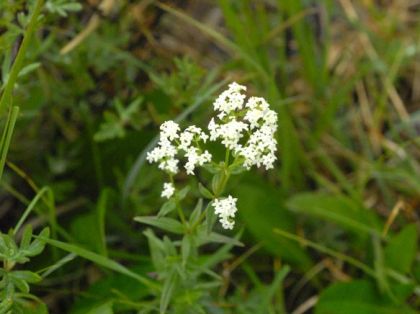
Common Yarrow or Northern Bedstraw?

It was a dark and stormy afternoon . . . no, really!  Tuesday afternoon at Colorado’s Golden Gate Canyon State Park was characterized by multiple rain-storms.  It was not ideal tent-camping weather.  Our tent was weather-proof, and the canopy over the picnic-table kept our cooking area dry.  On the other hand, we couldn’t venture far from camp.  Between downpours, my son trotted down to the little creek to float bits and pieces of wood down the increasingly quick current.  I, on the other hand, would wander around the campground, camera in hand, to look at the amazing variety of wildflowers that surrounded us.

I was amazed by the number of different kinds of plants; there must have been twenty to thirty different species within a 50’ radius of our fire-ring.  I’m no expert at botany.  My parents were pretty devoted wildflower people – identifying and photographing teeny little plants in the short grasses on mountainsides.  I dutifully went along – but not much of their passion stuck (at least the details of the plants).  So, a sojourn in the mountains this week brought back a lot of memories and an appreciation of the details associated with identifying the flowers.

There are a lot of plants that look similar!  The one above is known as “Northern Bedstraw”.  It was named/featured on a nature walk at the Visitor’s Center, but it was NOT in my Wildflowers of Colorado field guide.  What that book does contain are a lot of flowers that are similar, from “Common Yarrow” to “Cowbane” to “Caraway” – even “Cow Parsnip”!  I was able to eliminate pretty much all contenders except “Yarrow.”  To an experienced eye, there were probably many differences; I only noticed one frustratingly major one:  the leaves were different on the mystery plant.  And, in our campsite, the overwhelming majority of plants were Common Yarrow.

If I’d assumed, through a cursory glance over all of the white-clustered flowers, that they were all the same, I’d have missed the glory of Northern Bedstraw!*  Circumstances were such that I had the (almost necessary) luxury of delving a bit deeper into the wonders of wildflowers.  And I was reminded that our human tendency to “lump” – whether wildflowers, or people – can blind us to the significant, wonderful, differences found in creation, or human society.   It takes some discipline, but yields great rewards!


Blessings,


Gary


*  And, yes, early settlers used the plant as mattress-stuffing, finding it more resilient than regular straw!

Thursday, July 21, 2011

Out? Darned weeds! Out! . . . Really?*

        A week ago I spent a day at the Denver Botanical Gardens -- a sort of work/retreat.  It happened that I was there the day after a huge hailstorm had rumbled through Denver.  Wonderful plants had been battered to the ground; leaves and petals and branches were strewn about.  The gardener/horticulturists were out in force, cleaning up.  One of them commented to me that, when they arrived earlier that morning, they alternated between tears and busyness, as the day before everything was beautiful.  That was easy to see, even amidst the hail-carnage. As the day progressed, I watched a lot of picking up.  And I was struck by one worker, who stooped down and pulled up a weed.  A WEED!  In the Denver Botanical Gardens!  Why was I surprised?  Certainly, at my house, in my garden plots, weeds continually appear despite my (and Spectracide's) best efforts to keep them at bay.  Why should the Botanical Gardens be immune?
       Fast forward a few days, and I'm listening to a reading from the Gospel of Matthew (13.24-30), a parable Jesus told about wheat and weeds.  And I recalled that the Sunday prior, I heard another parable that included references to weeds (Matthew 13.1-23).  In both stories, the weeds are used as figures for something "bad".  And certainly, that was what the action of the gardener at Denver Botanical implied.  And I got to wondering about the (supposed) inherent "badness" of weeds.  I recalled Mary Douglas's definition of "dirt" as "matter out of place"**.  Are weeds simply plants out of place?
      I love the beauty of cultivated plants and flowers.  And crabgrass in the middle of my lawn seems to detract from the even-ness of the grass; I'll happily try to pull it out!  But is crabgrass "evil"?  Is it "bad"?  I guess not.  It's simply trying to do what it needs to do to survive.  As do dandelions and thistles.  On the other hand, some folks use dandelions to make wine; others have cultivated thistles to become delicacies:  artichokes.  It's a matter of perspective, not a matter of morals, it would seem.
      Some of this all came together when, in my email inbox on Tuesday, I received the following quotation:

It is very important to see your life not only from the narrow view of your egoistic telescope but also from the broad view of the universal telescope called egolessness. This is why we have to practice. Right in the middle of the stream of time, we have to open our eyes there and see the total picture of time. Through spiritual practice we can go beyond our egoistic point of view. We can touch the core of time, see the whole world in a moment, and understand time in deep relationship with all beings. 
 -Dainin Katagiri,  "Time Revisited" 

In a "universal telescope", daffodils and dandelions may simply be categorized as "plants".  The same is probably true for other distinctions we draw, using our egoistic (individual and societal) telescopes-distinctions of race, gender, class, political persuasion, etc..  Distinctions that may bring harm to us all when we start assigning moral categories to them.

Blessings,

Gary

*  With apologies to Lady Macbeth (Shakespeare, Macbeth Act 5, scene 1, 26-40).
**   I reflected on this last month in a different context last month.  You can find that meditation here .  It's the second of the two meditations on the page.

Friday, July 8, 2011

Between Lake and Mountain . . .

      . . . Lies True Meaning."  This is the "tag line" on the front of the current visitor's brochure for the Lan Su Chinese Gardens in Portland, OR.  The garden is the most authentic classical Chinese garden in the United States, built by artisans from Suzhou, China (one of Portland's sister cities).  Suzhou is renowned for its gardens-and I've visited several of them on a visit to China in the late '90's.  All of the materials (except for glass and plants) came from China to construct a full city-block version of Suzhou's landmarks.
      My family and I were there last Sunday towards the tail end of my vacation.  I had been to the garden at least once before, and I was struck again by its captivating beauty.  I was also struck by a sense of "slow-down" once we entered the garden.  That is, there was something about the place that almost required me to quit looking at my watch (even though we had a train to catch).  
     And then, there was that train trip.  Amtrak's "Coast Starlight" from Portland to Davis, CA.  A route down the Willamette Valley, and over the Cascade Range, and down that mountain range's east side.  Lakes and mountains (and trees) . . .  and no internet connection (and very sketchy cell phone coverage).  Again, almost a requirement to slow down.  Both at the garden and on the train I found myself wondering about my hurried pace of life, my semi-addiction to technology:  "What might happen without my input, or my knowing about it immediately?"  And what was I missing by NOT attending to that place "between lake and mountain"?
     Isn't that what a vacation is supposed to offer?  Something outside the normal, the seemingly pressing?  We speak of recreation, but do we connect it with re-creation?  A sabbath-time to rest from labors and ponder new vistas or vantage points.  A time simply to revel in relationships with loved ones.
     A few more weeks until it all starts up again in earnest around DU's campus.  LIttle time, then, to take stock, to wonder, to muse on the meaning between lake and mountain.  I'm going to try to make the most of the opportunities afforded by these days.
         
Blessings,

Gary

Friday, June 24, 2011

Bike Mind, Beginner's Mind


For those of you who live in a slightly less "snow-threatened" area, your Bike-to-Work day was last month -- sometime in May. Colorado has moved it to a more weather-predictable day; this year it was last Wednesday, June 22. For those of us who are pretty regular bike-commuters, it was easy to tell that something different was going on. There were certainly MANY more cyclists on the road during both the morning and evening commute. And I was asked a bike-route question at a reception that afternoon by someone who didn't find an easy way to cross a freeway. And, gosh, it'd be great if there were breakfast stations EVERY day!


A friend in my spin-class often talks about bike-commuting. When I saw him in the gym on Tuesday, he asked where the breakfast stations were situated. He was planning on trying it out (he only lives about a mile from his office). So, when I saw him on Wednesday, I asked if he DID bike commute. "No," he replied. He hadn't made the right preparations in logistical thinking the evening before and fell back on the normal mode of transport: car. Lesson one: change in patterns isn't easy!


While on my commute that morning, I was headed down a slight hill. Coming up the other side of the road was a young woman, walking her bike. Apparently she was someone who had decided to take the "bike-to-work" plunge and found that the "hill" that isn't noticeable in a car can be a bit of a lung-burner on bike. Lesson two: a change in perspective brings new appreciation for one's environment. I don't like that "hill" either, but I have learned that it gets easier with practice. I wanted to shout encouragement, but traffic prevented it. Regardless, I mentally applauded her for getting out of her car and attempting the ride (she WOULD have a downhill commute on the way home!). Lesson three: every journey begins with a single step (pardon the cliché).


One of the rationales behind Bike-to-Work day is to encourage people to try something new -- a different way of commuting. It is, in a way, a call to repentance, a call to make a change. For some the draw may be to pollute less; for others it may be to get more exercise. For most of us, making the decision to follow a different path was not easy; there are all sorts of "good reasons" why we can't make changes. On the other hand, when the lure is attractive enough, the benefits of making a change can certainly be worth the effort.


I often ask myself "where am I being challenged to change?" There are always many more answers/challenges than I have energy to address. And maintaining inertia is my usual response. So the lessons of this week's Bike-to-Work challenge are good reminders.


I hope the young woman I saw at the corner of Dahlia and Hampden keeps it up! She certainly inspired me to work through the difficulties of making a change. Best wishes to others in the same situation!


Blessings,


Gary


* With apologies, and homage, to Shunryu Suzuki's Zen Mind, Beginner's Mind (1970).

Sunday, June 12, 2011

Matter out of Place


In her brilliant (in my opinion) book, Purity and Danger, anthropologist Mary Douglas discusses "dirt". In different contexts, dirt means different things. In the garden, it's "soil" and it's good! On the white carpet, it's "dirt" and it's bad! Bodily fluids within the body, good! Bodily fluids coming out of the body, bad! Same stuff, different contexts. "Dirt," Douglas argues, "is simply matter out of place," and different cultures and religions calculate the "matter" and the "place" differently.


So do individuals (again in my opinion). I tend to see folks in one of two ways with regard to dirt: "clutter" people and "grime" people. I used to ask students who wanted to live in a residence I once managed how they would clean a kitchen. Some wanted bleach and scrub brushes; others were satisfied with a counter-brush and broom. The former were "grime" people; the latter "clutter". Having both on the same floor was, in my opinion, a good idea.


I don't want to place these folks in any hierarchical ranking. I freely confess that I'm a "clutter person"; my wife (thankfully) is a "grime person". When we set out to clean the kitchen, we know our specialties. There's no right or wrong (well, there isn't when we're in good moods, and not hurried!); there's simply a difference of perspective.


I've been thinking about this this week as I've been cleaning my office. Due to some construction elsewhere in the building, my furniture has been moved around quite a bit, and I've taken advantage of the upheaval to re-arrange my office. But what that means is that things I'd kept out-of-sight are now visible. And that means the whole office (finally) has to be straightened up. And, even though I'm a "clutter", the increase of debris and detritus over the last several years has NOT been dealt with adequately. Now's the time.


The end result will be wonderful, I'm sure! The process of de-cluttering is therapeutic . . . but, I'm finding, also very taxing. I'm realizing that, while I'm a "clutter person", I'm also a bit of a pack-rat; I'll save things "just in case". Talk about two contradictory personality traits! But the clutter has to go! And I find myself asking the question, "Why do/did I save THIS?" or "Do I need multiple copies of this brochure?"


Karen Kingston, in her book Clear Your Clutter with Feng Shui** (yes, I'll go to almost any end to deal with clutter!), suggests that there are several reasons for why people keep clutter. Most of them have some sort of spiritual counterpart; I'll leave you to figure out which apply to you (IF you're a clutter collector like me):

  • Keeping things "just in case" - indicates a lack of trust in the future (37)
  • Identity - the things help us feel secure in who we are, while also leading to the trap of being locked in the past (39)
  • Status - bolsters a low self-esteem (40)
  • Security - despite advertising, one will never have enough stuff to feel secure (41)
  • Territorialism - the ego striving to acquire and control things (42)
  • Inherited clutteritis - learned patterns from our parents (43)
  • A belief that more is better - how many kitchen knives DO we need? (44)
  • "Scroogeness" - have I gotten my money's worth? (45)
  • Using clutter to suppress emotions - filling empty space with stuff to avoid emptiness (45)
I'm willing to own up to the first, as well as those that have to do with falling to the advertisers' siren songs. I'm hopeful that some of the others don't apply to me!

But I am asking myself a lot of questions about the stuff that surrounds me. And I'm thinking about the recent Pixar movie "Up" in which one of the main characters doesn't really get what he wants until he is finally free of the stuff he thought was necessary. I'm trying to let go.

Feel free to stop by and ask how I'm doing! And feel free to say "no" if I offer you something to take away! It'd probably be (useless) matter from my place to yours.


Blessings,


Gary


*Subtitled: An Analysis of Concepts of Pollution and Taboo (first published in 1966, and revised, re-issued several times).


**New York: Broadway Books, 1999

Friday, May 27, 2011

Eschew Complexification

When I was in college, I was part of a singing group that traveled the Pacific Northwest (with forays to California, Utah and Montana). The group was really a promotional arm for the college; we would visit churches who supported the school, participating in worship, or giving concerts-raising money for the college. It was a great experience for the two years I was involved! In the process of giving the concerts, each member of the octet would usually be asked to introduce one of the upcoming songs. Some of us were more long-winded than others in our introductions. And when the words began to multiply, kissing sounds could be heard from other members -- a reminder to "Keep it short/simple, stupid".


I've been musing on simplicity over the last several weeks for a number of reasons (which I won't go into, to "keep it short"). The context hasn't been "living with less", but rather the ways that complexify our lives. One example: As I was growing up, I had a "to-do list" that outlined my chores for the day. It was a simple list. This morning, on the other hand, I spent quite a while categorizing, color-coding and prioritizing my "to-do's" for the day. Will that level of complexity help me get the tasks accomplished any better? Complexification!


Most of our religious traditions end up complexifying things pretty quickly. Rituals, liturgies, restrictions on food, special clothing, hierarchies, etc. "Routinization of charisma" is what sociologists call that pattern in the wake of a religious founder's death. The Buddha, for example, reputedly told his followers not to set up shrines to him. It wasn't too long after the Buddha's, death, however, that the shrines began popping up! Jesus is reported to have said (in brief), "Love God and love your neighbor. This is ALL the law and prophets" (Matthew 22.37-40). Jesus' followers often haven't seen that as sufficient.


This morning a friend (Thanks, Diana!) posted the following poem ("There was a time") by Ibn Arabi to her Facebook status update:


There was a time I would reject those

who were not of my faith.

But now, my heart has grown capable

of taking on all forms.

It is a pasture for gazelles,

An abbey for monks.

A table for the Torah,

Kaaba for the pilgrim.

My religion is love.

Whichever the route love's caravan shall take,

That shall be the path of my faith


Complexification, I think, contributes to the attitude of "rejection" the poet recalls. Whether or not I can accept everything the poem implies, it does-in the light of my pondering of simplicity-give me pause to wonder how much my own need to erect structures of security prevents "love's caravan" from reaching its destination.


Maybe it's time to return to those old college days: KISS! (Well, you know what I mean!!)


Blessings,


Gary